

A demo is just the beginning
HSI continues to support project development after the weekend ends.
Across our San Francisco and Seattle hackathons, engineers, product leaders, designers, nonprofit experts, entrepreneurs and community advocates have built tools that reached global policymakers, launched venture-backed companies, unlocked nonprofit funding, accelerated yearlong roadmaps, and created teams that kept working together long after the event.
Green Policy Agent
UNCCD asked participants to make the relationship between desertification, climate conditions and human outcomes legible to non-specialists. The winning team built a tool that answers natural-language questions about complex geospatial datasets — a user can ask why an area is highlighted and get an explanation drawn from environmental and socioeconomic data, without needing to read a map technically.
After the hackathon, HSI shared a demo with UNCCD representatives, who invited the whole team to present at COP16 in December 2024 with travel partially or fully funded. In weeks, a weekend prototype went from an early idea to a tool demonstrated to policymakers and national leaders.
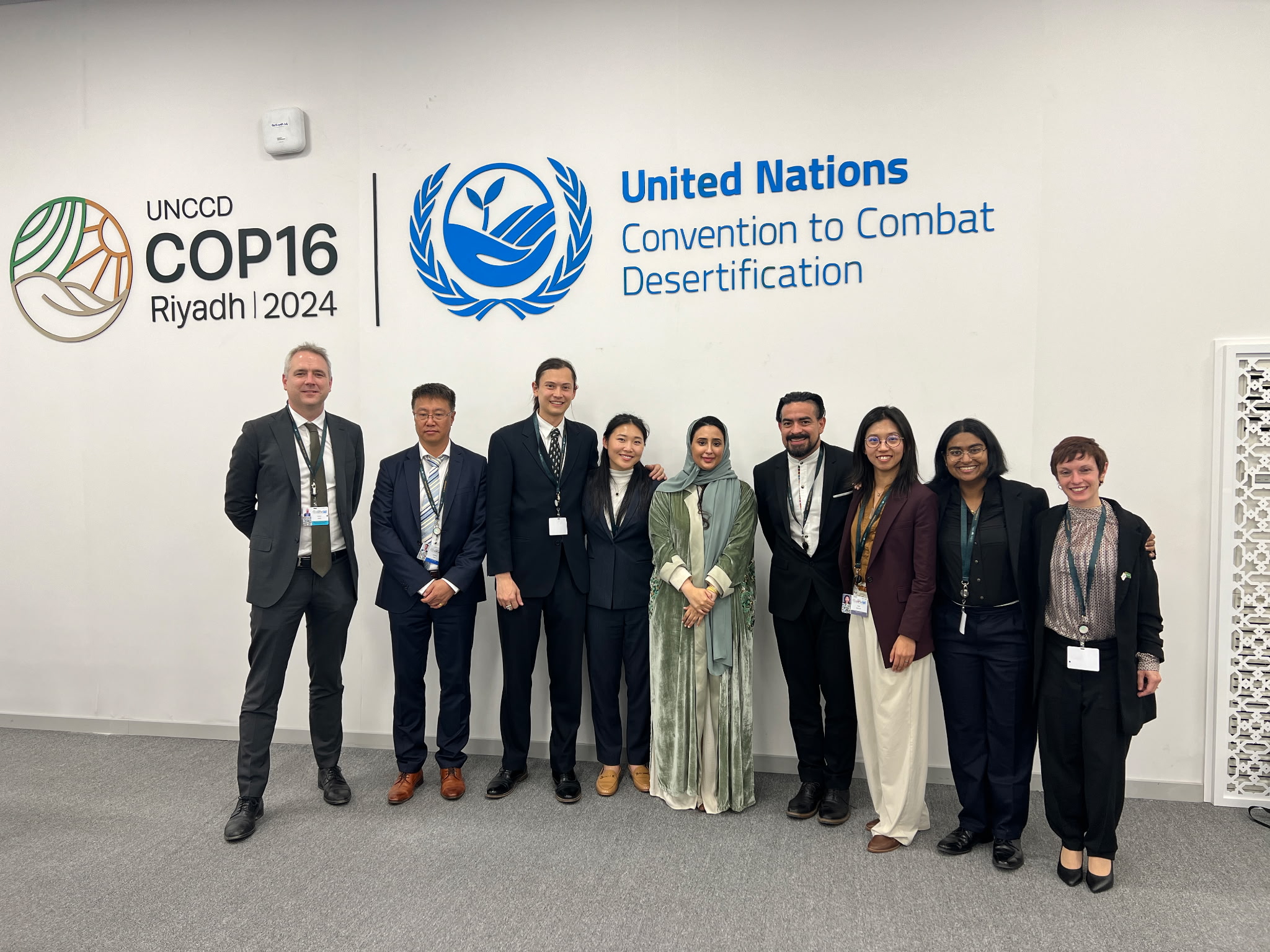
bild.ai
Fragmented building codes slow construction, raise costs and deepen the Bay Area's housing shortage. The team built a tool that reviews building plans against local codes, so developers can upload a blueprint, get an initial compliance assessment and catch problems before formal review. It does not replace public review — it helps teams submit compliant plans the first time.
The hackathon put Roop, a Columbia graduate who joined Google at 19, together with Puneet, who brought a decade of hands-on housing construction experience. Within days of placing second they were accepted into Y Combinator, and the company has raised since. In 2025 they returned to the hackathon as a sponsor, and gave the opening talk on going from a weekend prototype to a venture-backed company.
Comply AI showed us something we had not designed for: some public-interest problems can also sustain a business, and when commercial and social incentives line up, a company can scale impact far past one event.
Tenant Case Navigator
CLSEPA supports low-income tenants facing unsafe housing — mold, inadequate heating, other serious habitability problems — and had years of redacted decisions from past cases sitting unused. The team built a searchable tool that helps legal-aid professionals find relevant precedents, understand prior outcomes, and make better-informed decisions about damages and strategy.
The prototype did not go straight into implementation, but it established a concrete vision of what was possible. CLSEPA later secured a $7,000 grant to continue the work, issued an RFP, and HSI helped recruit development teams through its network. A team was selected in June 2026 and the project is in active development, heading toward a tool that could serve legal clinics and eventually tenants directly.

A one-year roadmap in four months
Hopelink arrived with a vague early idea and two years of development funding, but no dedicated technical team in its grant proposal and no affordable consultants. Before the event, HSI members with professional product-management experience helped sharpen the problem statement and technical spec. During it, several teams took on the challenge — evidence that builders found the problem compelling and that there were practical ways to solve it.
The solution that emerged differed from Hopelink's original specification, and was stronger for it. The organization connected with participants who became invested in the mission and kept volunteering afterwards. Its own estimate had been a year; the prototype was ready for user testing in about four months including preparation. Teams built on credits from Lovable, an HSI technology sponsor, and Hopelink later bought Lovable seats to carry the real product forward.
Talent, and a more ambitious direction
Hope Strategic came in as a young social enterprise led by a solo founder, with volunteer support for user research and UX but no technical team. Unlike most partners it already had a fairly clear product spec — and the hackathon changed its thinking anyway. Five teams worked the same challenge and produced five distinct approaches.
Seeing those possibilities widened the founder's sense of what the product could be. Hope Strategic hired one of the participants to continue full-time, and is now building its original app concept while also exploring a more ambitious smart-glasses approach that came out of the event.

A rapid innovation lab
EFF took part virtually, which turned out to matter: a partner does not have to be in the room to get real value. A representative stayed available throughout to answer participants' questions, and participants explored how data-driven educational material could work for audiences without deep technical or data expertise.
EFF came away with a solution it can implement using its existing development capacity. For an organization that already has engineers, the hackathon worked as a brainstorming environment and a litmus test rather than a source of technical labour — which is how partners at very different levels of technical maturity can each get something out of the same event.

A journalism startup
A team built for the Center for Investigative Reporting and stayed together after the event to keep developing it.
They took the prototype into an active startup and went on to Founder Institute to scale it further.
We are following through with our 2025 San Francisco partners, so more stories from that year are on the way.
Nonprofit, NGO, and government partners (sample)





A repeatable model
Partners bring deep knowledge of urgent problems. Participants bring technical, creative and product skills. We build the structure that lets them find each other, define a viable challenge, and keep the relationship going after the event.
- A climate-data tool presented at an international policy conference
- A housing-technology startup accepted into Y Combinator
- A legal-aid prototype revived through grant funding
- A nonprofit roadmap accelerated from one year to four months
- A social enterprise hiring technical talent directly from the event
- An established digital-rights organization testing new approaches to public education
- New teams and communities formed around a shared commitment to social impact
Contact
We would love to hear from you, whether you are a nonprofit, a sponsor, press, a participant, or have something else in mind.